CBHD’s North Carolina Save Hemp Campaign
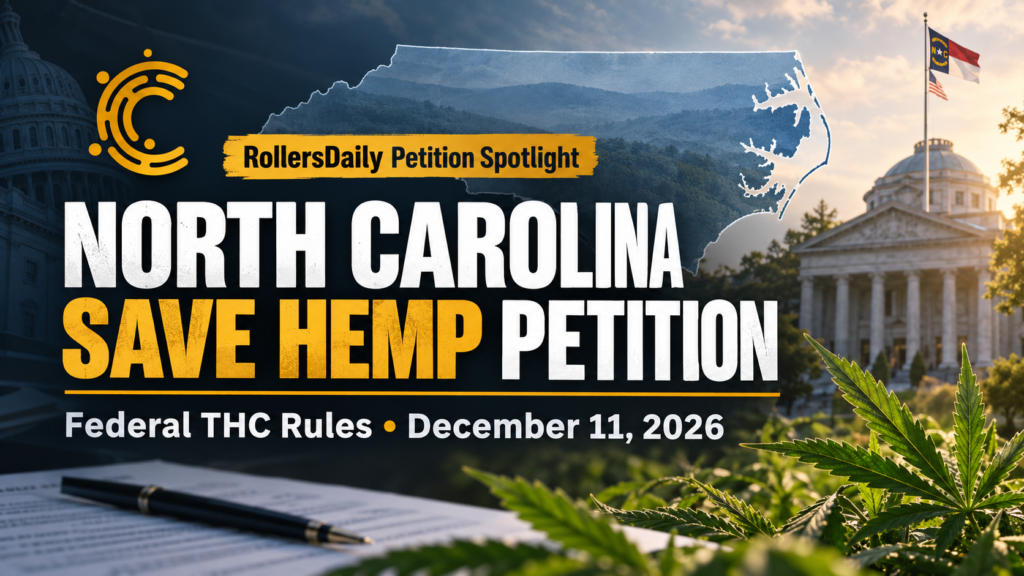
The second campaign comes from CBHD, which describes itself as an independent North Carolina organization focused on news, advocacy and education surrounding hemp and other plant-based industries. CBHD News
CBHD’s current homepage prominently warns visitors about the December 11 federal deadline and invites North Carolinians to sign a hemp petition asking Washington to choose regulation rather than prohibition. CBHD News
Its campaign brings an important state-level perspective into the federal debate.
CBHD says North Carolina has thousands of jobs connected to its hemp cannabinoid economy and argues that the federal changes could have significant consequences for businesses operating within the state. Those economic figures are advocacy estimates cited by CBHD and should not be treated as independent federal projections. CBHD News
But there is something RollersDaily noticed while fact-checking the petition that readers should know.
The CBHD Petition Page Currently Mixes Two Different Issues
The specific page provided to RollersDaily is titled as a North Carolina Federal Save Hemp Petition 2026.
However, the visible text on that page currently tells users:
“Help CBHD in North Carolina get Senate Bill 265 passed.” CBHD News
That is important because North Carolina Senate Bill 265 is not the federal hemp bill.
It is a North Carolina state proposal.
CBHD’s broader website clearly runs a federal Save Hemp campaign centered on the December 11 deadline, while this particular petition page currently appears to contain state-level SB 265 language.
That may be intentional because CBHD is advocating on both fronts—or it may simply be older petition copy remaining on the page.
Either way, readers should understand the distinction before signing.
What Is North Carolina Senate Bill 265?
North Carolina Senate Bill 265 is called the Protecting Our Community Act.
The bill was introduced in March 2025 and would create a regulatory structure governing hemp-derived consumable products in North Carolina.
Its stated purpose includes regulating the sale and distribution of hemp-derived consumable products and banning those products from school grounds. North Carolina General Assembly
The proposal includes licensing requirements for manufacturers, wholesalers and retailers and creates enforcement provisions around regulated hemp-derived products. North Carolina General Assembly
But it is important to be precise about its status:
According to the North Carolina General Assembly, SB 265 has not become law.
Its most recent listed action was referral to the Senate Rules and Operations Committee on March 12, 2025. North Carolina General Assembly
So CBHD’s support for SB 265 is advocacy for a proposed state regulatory system—not a description of current North Carolina law.
Why Does SB 265 Matter to the Federal Debate?
The connection is philosophical more than procedural.
Both AHAA and CBHD are pushing the idea that lawmakers should create rules for the hemp cannabinoid market rather than eliminate much of it through federal classification changes.
For AHAA, that effort centers directly on H.R. 9830.
For CBHD, the strategy includes both federal advocacy and efforts to create a clear North Carolina regulatory framework.
CBHD has also commissioned and published polling around SB 265 and advocates for age controls, business regulation and state oversight instead of allowing the market to remain in a legal gray area. CBHD News
That makes the two campaigns related—but they are NOT interchangeable.
AHAA
National organization.
Federal petition.
Supports H.R. 9830.
Focused directly on changing or delaying Section 781 before December 11.
CBHD
North Carolina-focused advocacy organization.
Running a broader federal Save Hemp campaign.
Also advocating for North Carolina SB 265 as a state regulatory structure.
The petition URL supplied to RollersDaily currently references SB 265 even though its title refers to the federal Save Hemp campaign. CBHD News
That clarification is important if these campaigns are going to be presented accurately.
A Major Thank You to CBHD
RollersDaily also wants to give a major thank you to CBHD for keeping North Carolina hemp consumers, retailers, farmers and other stakeholders engaged with what is happening at both the federal and state levels.
The hemp policy situation is complicated enough already.
Federal definitions are changing.
State laws can be completely different.
Bills are introduced without necessarily becoming law.
Deadlines get delayed.
And consumers can easily see “hemp ban” in a headline without understanding what portion of the market is actually affected.
Organizations that publish bill information, advocacy resources and educational materials give people more opportunities to investigate the issue themselves.
Readers can review CBHD’s campaign here:
These Petitions Are Similar—But They Are Not the Same
This is probably the biggest takeaway.
Both organizations are trying to prevent the upcoming federal changes from eliminating large portions of the existing hemp-derived cannabinoid market.
But they are approaching the issue differently.
AHAA is asking Congress specifically to support a named federal bill that would replace Section 781 with a national regulatory system.
CBHD is mobilizing the North Carolina hemp community against the federal changes while also pushing for a state-level regulatory framework.
Those are two different legislative tracks.
And because RollersDaily wants this coverage to remain legally accurate, we are not going to blur them together simply because both campaigns use the phrase “Save Hemp.”
What Happens If Congress Does Nothing?
If Congress does not repeal, replace or further delay Section 781, the broader federal hemp definition changes are scheduled to apply beginning December 11, 2026. GovInfo
That would not make every hemp product illegal.
But products that no longer meet the revised federal definition of hemp could lose the protections that previously separated hemp from marijuana under federal law.
That includes the controversial finished-product threshold exceeding 0.4mg combined total THC and certain similar cannabinoids per container. US Codex
The exact consequences for individual products can depend on their formulation, cannabinoid content and other factors.
Businesses dealing with compliance should speak with qualified legal counsel rather than relying on social-media summaries or advocacy materials alone.
This Debate Is Bigger Than Delta-8
The hemp conversation started years ago with products such as delta-8 THC.
It is now much larger.
The incoming federal definition reaches issues involving:
THCA.
Hemp-derived delta-9 products.
Other intoxicating cannabinoids.
Certain synthetic or manufactured cannabinoids.
And potentially some full-spectrum cannabinoid products containing trace levels of THC.
That is why businesses from growers to manufacturers to retailers are paying attention.
This is no longer a niche argument over one cannabinoid.
It is a debate over what the American hemp-derived cannabinoid market will legally look like after December 11.
What Should Consumers Do?
First, understand what you are signing.
Petitions are advocacy tools.
Signing one does not change federal law by itself.
But petitions can be used by organizations to demonstrate constituent or industry support when speaking with lawmakers.
Second, verify the legislation being referenced.
For AHAA, that means reading H.R. 9830.
For CBHD, that may mean understanding both the federal Section 781 debate and North Carolina Senate Bill 265.
And third, remember that neither H.R. 9830 nor SB 265 is currently enacted law.
They are proposals.
The December federal changes, however, are already contained in enacted federal law unless Congress changes them again before they fully take effect. GovInfo
The Hemp Industry Is Running Out of Time
December 11 is approaching quickly.
AHAA wants Congress to replace Section 781 with a national regulatory framework.
CBHD wants North Carolina residents participating in the federal fight while also supporting state-level regulation.
Whether lawmakers ultimately adopt either approach remains unresolved.
But one thing is already clear:
The hemp industry is no longer debating some hypothetical law years in the future.
The federal deadline is now measured in weeks.
And both organizations are trying to make sure hemp businesses and consumers are paying attention before the rules change.
Readers can review CBHDs Campaign here: