American Healthy Alternatives Association
The American Healthy Alternatives Association, or AHAA, describes itself as a national 501(c)(6) trade association representing businesses and consumers involved with hemp-derived products and other healthy-alternative industries. USAHAA
Its message is straightforward:
“Regulate it. Don’t eliminate it.”
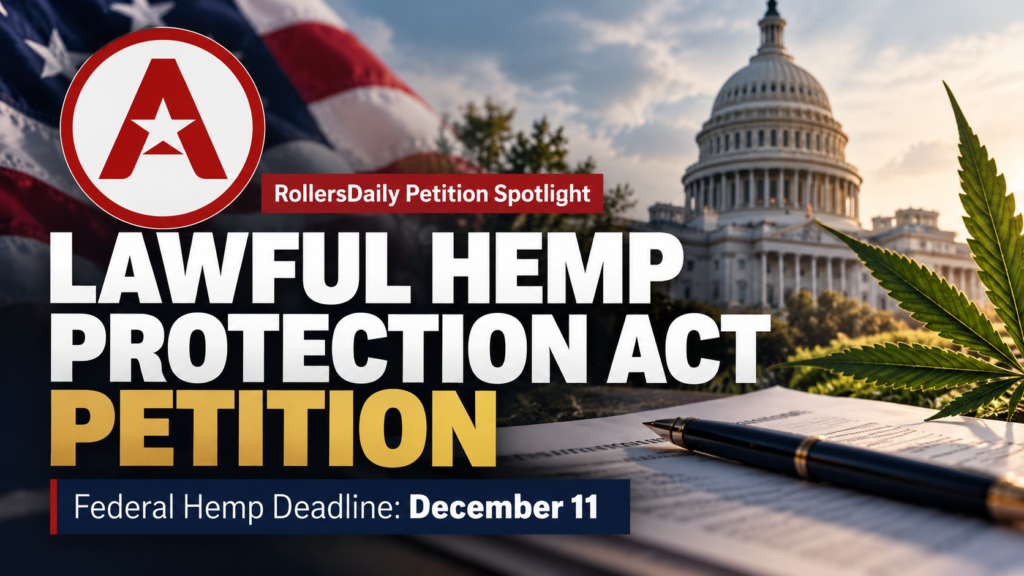
AHAA’s national petition asks Congress to support the Lawful Hemp Protection Act, H.R. 9830, rather than allowing the broader Section 781 restrictions to take effect unchanged on December 11. USAHAA
What Is H.R. 9830?
The Lawful Hemp Protection Act was introduced in the House on July 22, 2026, by Rep. Andy Barr of Kentucky and Rep. Angie Craig of Minnesota.
As of the current federal record, the bill has been referred to the House Committees on Ways and Means, Energy and Commerce, Agriculture, and Transportation and Infrastructure.
It has not passed the House, passed the Senate or become law. GovInfo
That distinction matters.
A petition supporting H.R. 9830 is asking lawmakers to support proposed legislation. It is not asking them to enforce a law that already exists.
What Would the Lawful Hemp Protection Act Do?
The bill takes a very different approach from Section 781.
Instead of using the 0.4-milligram finished-product threshold as the central federal rule, H.R. 9830 would repeal Section 781 and establish a dedicated regulatory structure for hemp-derived cannabinoid products. GovInfo
Among other provisions, the introduced bill would prohibit sales of hemp-derived cannabinoid products to people under 21 years old. GovInfo
It would also establish federal labeling requirements.
Labels would have to identify THC content per serving and package, state that the product is intended for people 21 and older, carry government warnings, disclose ingredients and cannabinoid content, and provide access to testing results through a QR code, web address or similar mechanism. GovInfo
The bill also directs federal regulators to establish uniform manufacturing and testing standards and requires testing through appropriately accredited laboratories. GovInfo
And unlike the 0.4mg-per-container rule, the bill contains a framework for allowable THC levels.
If federal regulators failed to establish different maximum amounts within the required timeframe, the introduced bill would default to:
5mg THC per serving for orally consumed products
50mg per serving for inhalable hemp-derived cannabinoid products
50mg per serving for topical products GovInfo
Those numbers are part of the proposed bill and should not be confused with current federal law.
AHAA Also Wants a Backup Plan
AHAA says that if Congress cannot pass a regulatory framework before December 11, its fallback request is a two-year delay of Section 781 so lawmakers have more time to develop new rules. USAHAA
That means its campaign essentially has two goals:
Pass H.R. 9830 or another regulatory solution.
Or delay the incoming federal redefinition while lawmakers continue working.
AHAA also encourages supporters to contact members of Congress directly in addition to signing its petition. USAHAA
A Major Thank You to AHAA
RollersDaily wants to give a major thank you to the American Healthy Alternatives Association for making its advocacy materials, legislative references and petition publicly available to consumers and businesses trying to understand what is happening.
Whether somebody ultimately agrees with AHAA’s preferred legislation or not, giving the public direct access to the bill number, deadline and proposed regulatory alternative makes it easier for the cannabis and hemp communities to research the issue for themselves.
Readers can review AHAA’s campaign here:
Editorial Transparency
Editorial Transparency: RollersDaily uses AI-assisted tools to support content development and reporting. Topics are independently selected by our editorial team, with articles reviewed, edited, and fact-checked by humans before publication. Our goal is to deliver accurate, relevant, and informative coverage to the cannabis community.
Disclaimer
This article is provided for news and educational purposes only and does not constitute legal advice, lobbying advice or an endorsement of any candidate or political party. Legislative proposals and deadlines can change, and readers should review official government records and qualified legal guidance when making compliance decisions.
Sources
U.S. Government Publishing Office; North Carolina General Assembly; American Healthy Alternatives Association; CBHD.