
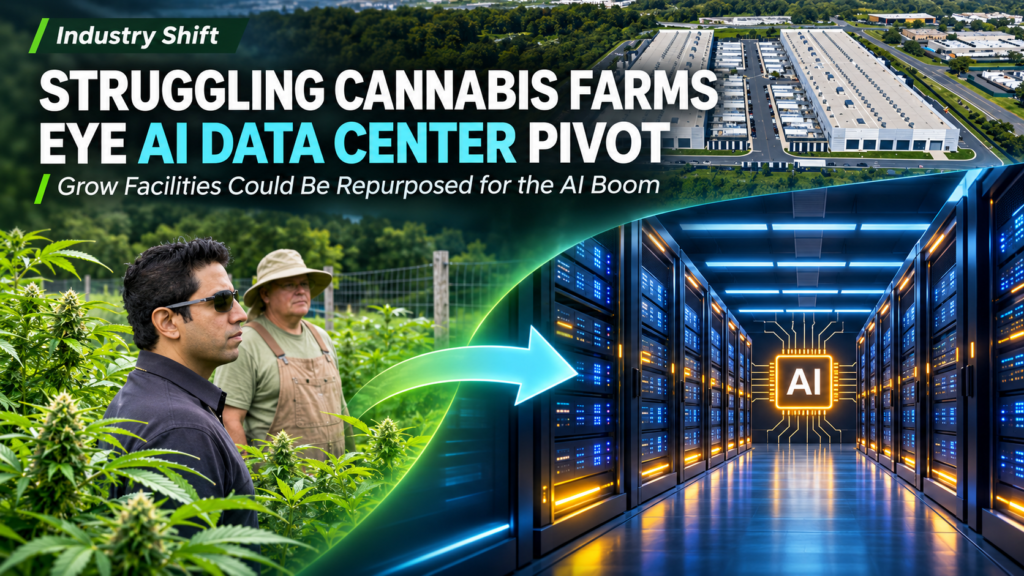
Struggling Cannabis Farms Are Eyeing AI Data Centers as a New Lifeline
Cannabis farms AI data centers might sound like an unlikely combination, but struggling marijuana cultivators are beginning to explore whether expensive grow facilities could find a second life supporting artificial intelligence infrastructure. As wholesale cannabis prices fall and operating costs remain high, some growers and property owners are looking beyond cultivation for ways to reuse buildings already equipped with heavy electrical capacity, industrial cooling systems and other valuable infrastructure.
Why Would an AI Company Want a Cannabis Grow Facility?
Modern indoor cannabis cultivation is an infrastructure-heavy business.
Large facilities can require high-capacity electrical service, industrial HVAC systems, cooling equipment, extensive climate controls, security systems and specialized building upgrades.
MJBizDaily reports that these similarities have attracted attention from data-center developers looking at distressed cannabis properties.
Commercial cannabis real-estate professionals say adaptive reuse can make sense because many of these buildings were already designed for continuous, energy-intensive operations.
Power and Cooling Are the Biggest Attraction
Electricity is one of the most valuable pieces of the equation.
Cannabis cultivation requires powerful lighting, cooling and dehumidification systems operating for long periods every day.
MJBizDaily reported in June that indoor cannabis cultivation can consume roughly 50 times more electricity per square foot than a typical office building.
At the same time, electricity prices have been squeezing cultivators even further. U.S. electricity costs increased 5.9% during the 12 months ending May 31, according to data cited by MJBizDaily.
That means cannabis growers are already sitting inside buildings designed around something AI developers desperately need:
Power.
Cannabis Facilities Can Offer More Than Electricity
The potential overlap doesn’t end there.
Some cultivation facilities already have industrial-grade cooling, insulation, water infrastructure, fiber connectivity and layered security.
Data centers require many of those same systems to keep thousands of servers operating reliably.
That does not make cannabis grows turnkey data centers.
But when a developer can reuse expensive infrastructure instead of starting from an empty warehouse or raw land, the property can suddenly become much more interesting.
Falling Cannabis Prices Are Driving the Search for Alternatives
This AI pivot is not happening because cannabis companies suddenly want to become technology businesses.
For many operators, it is about survival.
MJBizDaily reports that cannabis cultivation businesses have been pressured by a combination of rapidly expanding supply, falling wholesale prices and competition from unregulated hemp-derived THC products.
Some growers have reduced their cultivation footprint. Others have shut facilities entirely or begun looking for alternative tenants and buyers.
Energy costs create another problem.
Indoor cultivation facilities consume massive amounts of electricity, but cannabis operators cannot always raise retail or wholesale prices enough to compensate for those higher expenses.
That leaves some companies owning expensive buildings originally constructed during a more optimistic period for legal cannabis.
Now those buildings need another purpose.
One Michigan Cannabis Facility Shows Why the Idea Is So Tempting
Harbor Farmz in Kalamazoo, Michigan became one of the highest-profile examples of the cannabis-to-data-center concept.
Founder Michael Ward and investors reportedly spent approximately $20 million building the roughly 33,000-square-foot cultivation facility in 2020.
Forbes reported that marijuana flower was selling for around $2,500 per pound when the facility was built. Ward said pricing had since fallen to roughly $700 per pound.
The company also reduced its cultivation footprint as the economics became increasingly difficult.
The building, however, had something potentially valuable to another industry.
Infrastructure.
The Facility Already Had Serious Electrical Capacity
According to Forbes, the Harbor Farmz property had approximately 1.5 megawatts of electrical capacity, with the potential to reach around 2.5 megawatts relatively quickly and potentially as much as 15 megawatts over the longer term.
The property also had fiber infrastructure and sophisticated HVAC systems.
Those features made Ward believe the building could potentially serve as a smaller AI inference data center rather than a massive hyperscale facility.
For a struggling cannabis operator, the economics are obvious.
A specialized grow facility may not be worth anywhere near its original construction cost to another cannabis company.
A technology developer that values its electrical infrastructure could potentially see something very different.
But Turning Cannabis Grows Into AI Data Centers Isn’t Easy
This is where the hype runs into reality.
Most cannabis facilities simply do not have enough power or space for major data-center operations.
MJBizDaily reported that many cultivation facilities have around 3 to 5 megawatts of electrical capacity, while larger data centers can require well over 10 megawatts.
Most cannabis cultivation facilities are also much smaller than the buildings traditionally used for major data centers.
A Grow Facility Is Not Automatically a Turnkey Data Center
The infrastructure overlap is real, but the buildings serve fundamentally different industries.
Servers can demand substantially more power than cannabis grows.
Data centers also have specialized redundancy, security, connectivity and engineering requirements.
Forbes reported that real-estate professionals have seen plenty of cannabis property owners pitching their buildings as potential data centers without seeing many transactions actually close.
So while the idea sounds like an easy second life for distressed cannabis properties, the reality may be far more selective.
Community Opposition Can Stop a Conversion Before It Starts
The Harbor Farmz example demonstrates another major obstacle:
Local politics.
Forbes reported that Kalamazoo initially approved zoning that would allow the Harbor Farmz property to become a data center.
But residents later raised concerns about issues commonly associated with large data-center developments, including electricity demand, noise, water consumption and pressure on the local electrical grid.
The city ultimately adopted a data-center moratorium through August 2027, effectively stopping the Harbor Farmz proposal for the time being. Ward removed the listing in September.
That means having the correct building does not necessarily mean a project will happen.
A successful conversion may require the right property, utility capacity, zoning, community support, fiber access, tax structure and buyer — all at the same time.
Smaller AI Data Centers May Be the More Realistic Opportunity
There may still be a middle ground.
Not every future AI facility needs to resemble the enormous hyperscale data centers being developed by the world’s largest technology companies.
Forbes reports growing interest in smaller regional and inference-focused data centers that can operate with significantly less power than giant AI training campuses.
Those smaller facilities may create opportunities for certain cannabis properties that would never qualify for hyperscale development.
MJBizDaily also reported an example where a cannabis tenant reduced its cultivation footprint and a landlord brought in a data-center operator using shipping-container infrastructure to occupy unused space.
That raises an even more unusual possibility:
Cannabis cultivation and computing infrastructure operating from the same industrial property.
What This Says About the Cannabis Industry in 2026
The biggest story here may not actually be AI.
It may be what these conversations reveal about cannabis.
During the expansion of legal marijuana markets, operators invested enormous amounts of money building cultivation facilities designed for what many expected would be massive and sustained demand.
In several mature markets, supply expanded faster than demand.
Wholesale prices fell.
Operating expenses remained high.
And the infrastructure once viewed as an advantage became expensive overhead.
Now some cannabis companies are looking at the AI boom and realizing the most valuable thing about their grow facility might eventually have nothing to do with cannabis.
The electrical connection could be worth more than the grow rooms.
The cooling system could attract a technology company.
The fiber connection could suddenly become part of the property’s sales pitch.
That would have sounded ridiculous during the cannabis investment boom.
Today, it is a legitimate real-estate strategy.
Cannabis Farms Aren’t Becoming AI Data Centers Everywhere — Yet
It is important not to exaggerate what is happening.
There is currently no mass conversion of American cannabis farms into AI facilities.
Industry reporting shows interest, property listings, proposals and developers examining opportunities — but also projects failing because of power limitations, building size, zoning restrictions, community resistance and economics.
For the right property in the right market, however, the crossover may make sense.
And as both industries evolve, some of the buildings created during America’s cannabis boom could eventually become infrastructure for America’s AI boom.
That is a sentence we definitely didn’t expect to be writing.
What Do You Think?
Would converting underused cannabis cultivation facilities into smaller AI data centers be a smart way to reuse expensive infrastructure?
Or should operators hold onto these properties and wait for cannabis markets to recover?
The cannabis industry has reinvented itself plenty of times already.
Its next unexpected pivot might involve fewer grow lights — and a whole lot more servers.
Sources: MJBizDaily, Forbes and reporting republished through Yahoo Tech.
Editorial Transparency: RollersDaily uses AI-assisted tools to support content development and reporting. Topics are independently selected by our editorial team, with articles reviewed, edited, and fact-checked by humans before publication. Our goal is to deliver accurate, relevant, and informative coverage to the cannabis community.