The Cannabis World Is Moving Fast Right Now
The Cannabis World Is Moving Fast Right Now — Here’s Everything You Need to Know This Week
Category: Cannabis News & Legislation Published by: RollersDaily Reading time: ~7 minutes SEO Keywords: cannabis news July 2026, DEA rescheduling hearing 2026, World Cup cannabis, Texas THC ban 2026, Kentucky medical cannabis prices, cannabis union 2026, California cannabis news, legal weed 2026
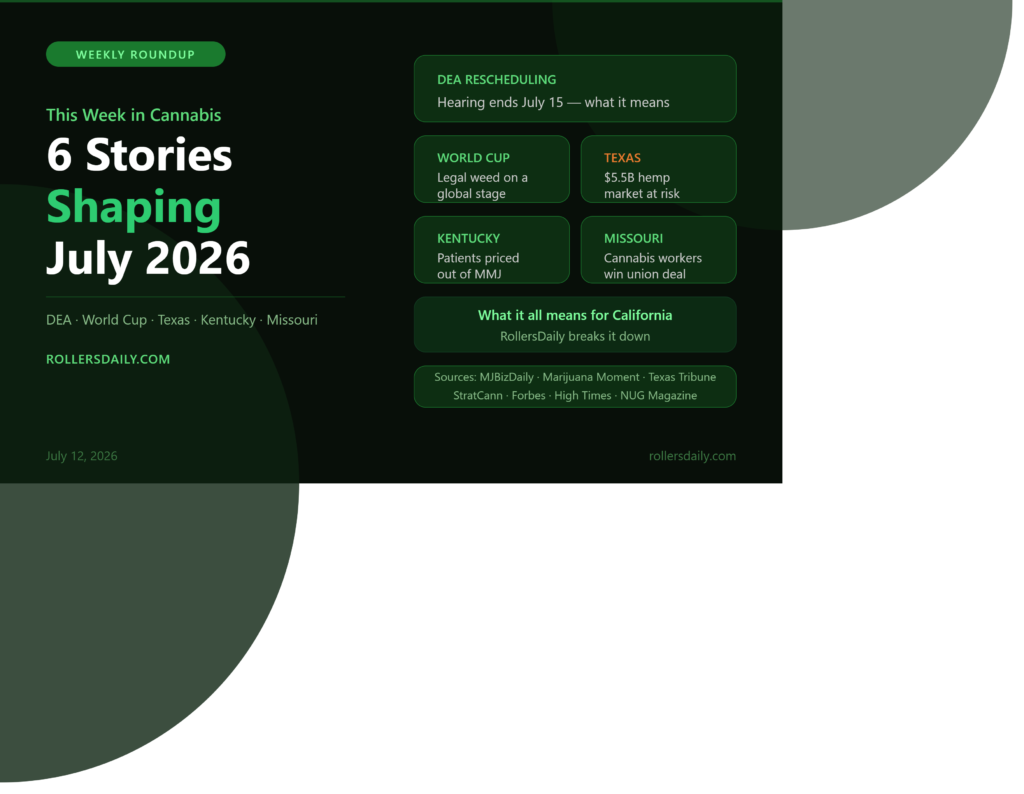
July 2026 is one of the most active weeks in cannabis news in years. The DEA rescheduling hearing is wrapping up. The FIFA World Cup is putting legal cannabis on a global stage. Texas is trying to wipe out a $5.5 billion hemp market. Kentucky patients are getting priced out of their own medical program. And Missouri cannabis workers just made union history.
We pulled from every major source so you don’t have to. Here’s the full picture — in RollersDaily’s voice, built for the California cannabis community that deserves to stay informed.
1. The DEA Rescheduling Hearing Is Almost Over — Here’s What It Actually Means
The most consequential moment in federal cannabis policy in decades is happening right now — and it ends July 15, 2026.
The Drug Enforcement Administration launched a formal administrative hearing on June 29 to determine whether marijuana should be rescheduled from Schedule I to Schedule III under the Controlled Substances Act. This isn’t a congressional vote. It’s a legal process that could reshape the financial and regulatory landscape for every cannabis business in America.
Here’s the honest breakdown of what rescheduling would and wouldn’t do:
What it would do:
- Allow cannabis businesses to deduct standard business expenses from federal taxes — something currently blocked under the 280E tax code
- Signal a federal softening on marijuana policy for the first time in decades
- Create a path toward Medicare coverage for FDA-approved cannabis medicines
- Provide financial relief estimated at hundreds of thousands of dollars per dispensary annually
What it would NOT do:
- Legalize recreational cannabis at the federal level
- Make Visa or Mastercard available at dispensary registers
- Force every bank to serve cannabis businesses
- Erase the state-by-state compliance patchwork that operators navigate daily
One voice inside the hearing said it plainly: the process matters, but it doesn’t address the lasting harms of cannabis criminalization — the arrests, convictions, and collateral consequences that reshaped entire communities for decades. Rescheduling is a financial and regulatory step. It is not justice reform.
RollersDaily will have results the moment the ruling drops. Watch this space.
2. The FIFA World Cup Just Put Legal Cannabis on a Global Stage — California Included
Something historic is happening right now that the mainstream sports world isn’t talking about enough: the 2026 FIFA World Cup is the first World Cup ever held in countries where you can walk into a licensed shop and legally buy cannabis.
Millions of international fans — many from countries where cannabis is still fully prohibited — are having their very first encounter with legal cannabis this summer in American cities. Dispensaries in Los Angeles, Seattle, New York, New Jersey, Boston, and Kansas City are seeing a surge of curious first-time customers who have never experienced a legal, regulated cannabis purchase before.
For California — and for RollersDaily’s community — this is a massive cultural moment.
But there are real rules every fan and local needs to know:
What’s legal:
- Adults 21+ can legally purchase cannabis from licensed dispensaries in California and other legal states
- Los Angeles is a legal purchase city — dispensaries are open and serving World Cup visitors right now
- Canada (Vancouver, Toronto) has federally legal cannabis — the most straightforward experience for international fans
What is absolutely NOT allowed:
- Cannabis is banned at every single World Cup stadium and FIFA fan zone — no exceptions, regardless of local law
- Possession inside a stadium can result in immediate ejection and arrest
- Carrying cannabis across state lines or international borders is a federal offense — yes, even from one legal state to another via airport
- Mexico has no legal recreational dispensaries — buying from unlicensed sources carries serious legal risk
The contrast that’s been highlighted all week: cities bent over backwards to make alcohol easier to access for World Cup fans. Extended bar hours, outdoor drinking zones, special permits for public watch parties. Cannabis — a legal industry in half the country — got none of that regulatory creativity.
That double standard is worth paying attention to. And for California cannabis consumers watching international fans discover legal weed for the first time — welcome to what we’ve had since 2016. 🌿
3. Texas Is Trying to Kill Its $5.5 Billion Hemp Market — And It’s Getting Wild
Texas doesn’t have legal recreational cannabis. But it has had a booming hemp-derived THC market — delta-8, THCA flower, vapes — sold in smoke shops across the state. That market was worth an estimated $5.5 billion. And Texas lawmakers are trying to shut it down.
Here’s the chain of events:
A Texas appeals court ruled on June 26 not to extend an injunction that had kept THCA legal to sell. THCA — which converts to THC when heated — is now effectively banned from Texas smoke shops. Overnight, retailers were left scrambling.
The workaround? THCP — a naturally occurring cannabinoid that is reportedly 30 times more potent than delta-9 THC in how it binds to brain receptors. Smoke shops are already stocking it, and attorneys are calling it “fair game” since it isn’t explicitly named in the current rules.
But here’s the catch nobody should ignore: nobody fully knows the effects of THCP at the concentrations being used in commercial products. The manufacturing process to concentrate it from hemp involves chemical alteration. And there is zero regulatory oversight on what’s actually in those products.
This is exactly the kind of situation the California licensed cannabis market was built to avoid. Lab-tested, labeled, regulated products sold by accountable retailers. When the unlicensed and unregulated market gets squeezed, it doesn’t disappear — it shapeshifts into something potentially more dangerous and less understood.
Texas’s Senate Health and Human Services Committee held another hearing this week pushing toward a full THC ban. A final vote could come in 2027. The $5.5 billion question is what happens to the market — and the consumers in it — if it does.
4. Kentucky Medical Cannabis Is Open — But Patients Are Getting Priced Out
Kentucky launched its medical cannabis program in December 2025. It was celebrated as a major win for patients in a Southern state that had resisted legalization for decades.
Six months in, the celebration has gotten complicated.
Kentucky lawmakers heard testimony this week that medical cannabis prices in the state are simply too high for many patients to afford. The infrastructure is there. The licenses were issued. The dispensaries opened. But the cost of the product is pricing out the very people the program was designed to serve.
And as of July 1, 2026, Kentucky medical patients can no longer purchase cannabis from out of state and bring it back. The window that existed during the rollout period — when patients could source from neighboring legal states — is officially closed. Now they must purchase exclusively from Kentucky licensed retailers, at Kentucky prices, with no competitive alternatives.
This is a pattern that plays out in every new cannabis market: the regulatory framework launches before the supply chain is mature enough to drive prices down. It takes time, competition, and scale to bring costs to a level that serves all patients — not just those who can afford premium pricing.
California went through this. It is still going through it on the illicit market side. The lesson for every emerging state program is the same: legalization is the beginning of the work, not the end of it.
5. Missouri Cannabis Workers Just Made Union History
Here is a story that deserves more attention than it’s getting.
Missouri cannabis workers at High Profile Cannabis in Columbia just unanimously ratified a new union contract through United Food and Commercial Workers International Local 655 — and organizers say the momentum is spreading across the state.
Cannabis workers forming and winning union contracts is significant for a few reasons:
It signals that the industry is maturing past its startup phase. In early legal cannabis markets, workers often accepted below-market pay and irregular conditions in exchange for being part of something new. That era is ending.
It raises the bar for what workers across the industry can expect — benefits, job security, fair pay, and representation. And it does so in Missouri, a state that only launched recreational cannabis in 2023, moving faster than most people expected.
For California — where labor rights and cannabis have intersected since the early days of Prop 64 — this is a reminder that the culture of the legal cannabis industry is still being written. The decisions workers, operators, and consumers make right now shape what that industry looks like for the next decade.
6. The Big Picture: What All of This Means for California Cannabis Consumers
Everything happening this week points in the same direction: the cannabis world is in a period of rapid, uneven change. And the decisions being made in federal hearing rooms, state legislatures, and union halls right now will determine what this industry looks like for the next ten years.
Here’s what the RollersDaily community needs to take away:
The DEA hearing — whatever it decides — represents the federal government finally engaging seriously with cannabis policy for the first time in generations. That’s meaningful even if the outcome is imperfect.
The World Cup moment — millions of people around the world are seeing legal, regulated cannabis for the first time this summer. California is part of that showcase. What they experience shapes global cannabis culture going forward.
The Texas situation — is a case study in what happens when regulation lags behind markets. Unregulated products fill the void. The California licensed market, for all its challenges, exists precisely to prevent that.
Kentucky’s pricing problem — is a reminder that legalization without accessibility isn’t enough. The legal market has to actually serve people to earn their loyalty over the illicit market.
Missouri’s union win — is proof that the cannabis industry is growing up. Workers organizing and winning is a sign of a maturing market, not a struggling one.
California is the oldest, largest, and most complex legal cannabis market in the country. Everything happening everywhere else is, in some way, a version of what California has already navigated — or is still working through.
RollersDaily is here every week with the context that makes sense of it. Stay informed. Buy legal. And find the licensed California dispensaries, delivery services, and brands that are doing this the right way at RollersDaily.com. 🌿
Find licensed California dispensaries near you at RollersDaily.com
Sources: Marijuana Moment Newsletter (July 6, 2026), MJBizDaily — World Cup Cannabis (July 6, 2026), MJBizDaily — Kentucky MMJ Prices (July 9, 2026), MJBizDaily — Missouri Cannabis Union (July 6, 2026), Texas Tribune — Texas THC Ban Hearing (July 7, 2026), Spectrum News Texas — THCP Workaround (July 7, 2026), Forbes — World Cup Cannabis Exclusion (June 12, 2026), Cannigma — World Cup Cannabis Guide, High Times — World Cup Weed Rules, NUG Magazine — Cannabis Industry Update July 2026, StratCann — Week in Weed July 11, 2026